
Navigation Explore Code Guide
Loop & Graph Engineering
Last updated:
Status: Loop engineering is practitioner vocabulary, not a formal standard. Graph engineering is an emerging research label, not a settled discipline. The underlying mechanisms, such as state machines, workflow graphs, checkpoints, and review gates, are mature engineering techniques.
Use this page for: designing the feedback and topology of an agent system. For runtime-harness components, security controls, and optimizer research, see Agent Harness Engineering. For product classification, see the Agent Harness Landscape.
Explicit contracts make feedback, stopping, routing, and acceptance testable; a longer prompt alone does not define those controls. A loop specifies feedback and stopping. A graph specifies the executable topology. A graph can contain a loop, but neither term establishes that an acceptance decision is correct.
Agent Harness Engineering owns the distinctions between a model, a runtime harness, a repository harness, and an orchestrator. Use it to identify which layer owns context, tools, permissions, verification, recovery, or coordination. This page focuses on the loop and graph contracts that make feedback and routing inspectable.
Contents
Section titled “Contents”- Choose the smallest control structure
- Write a loop contract
- Write a graph contract
- Static and dynamic graphs
- Allocate judgment explicitly
- Make execution durable
- Observe and evaluate the system
- Three implementation cases
- Anti-patterns
- Selection checklist
1. Choose the smallest control structure
Section titled “1. Choose the smallest control structure”Start with the simplest structure that can make the required decision safely.
| Need | Smallest suitable loop or graph structure | What must still be specified |
|---|---|---|
| One bounded task with local tool feedback | Agent loop | stopping rule, tool policy, local verifier |
| Known branches, retries, parallel work, or human interruption | Explicit workflow graph | state schema, routes, joins, checkpoint and recovery policy |
The diagram selects a control structure; Agent Harness Engineering defines the ownership boundary between a runtime harness, repository harness, and orchestrator.
Do not turn a single bounded task into a multi-agent graph just because a framework makes it easy. Every added component introduces state, overhead, and failure modes. Every verifier, reviewer, or release gate introduces an acceptance boundary to test.
The labels are intentionally narrow. Addy Osmani’s practitioner account is useful experience-based framing for replacing repeated prompting with a system that finds, dispatches, checks, and records work. It is not a standard or a performance study. The two recent preprints, Graph Engineering in the Era of LLM Agents and What Makes Prompts a Graph, propose graph-engineering vocabularies. Treat their definitions as research proposals, not proof that graphs improve every agent system.
2. Write a loop contract
Section titled “2. Write a loop contract”A loop contract makes “keep going until it works” testable. It names the unit of work, its permitted actions, the evidence that counts as progress, and every allowed exit.
| Field | Questions the contract must answer |
|---|---|
| Goal and input | What requirement, repository revision, and expected artifact define this run? |
| State | What facts persist outside the context window? Who may update them? |
| Actions | Which tools, credentials, files, and external effects are permitted? |
| Observation | Which tool outputs, tests, traces, and human feedback enter the next iteration? |
| Verification | Which deterministic checks, independent reviews, or human decisions can accept the work? |
| Stop and escalation | What ends success, ends failure, consumes budget, times out, or requires a person? |
| Evidence | Which commands, outputs, trace IDs, and versions prove the final claim? |
Apply the feedback horizons
Section titled “Apply the feedback horizons”Agent Harness Engineering defines the inner, outer, and meta horizons and their owning layers. Apply the loop contract at each boundary: an inner-loop contract records tool evidence and a local stop; an outer-loop contract names the delivery verifier and acceptance authority; a meta-loop contract versions the graph or harness change and evaluates it against held-out evidence. A model statement that it has finished is an observation, not acceptance evidence.
3. Write a graph contract
Section titled “3. Write a graph contract”Use an explicit graph when routing itself is material. The LangGraph Graph API is a concrete primary-source example: it represents shared state, nodes, fixed and conditional edges, and parallel execution. Nodes can contain LLM calls or conventional code. This is why a graph is not synonymous with a multi-agent system.
A graph contract should be reviewable without running the graph.
| Element | Minimum contract |
|---|---|
| Graph identity | graph and policy versions, owner, compatible state schema |
| State | typed fields, confidentiality, writer, reducer or conflict rule, retention |
| Node | purpose, input and output, idempotency boundary, timeout, side effects |
| Edge | source, destination, condition, routing evidence, forbidden transitions |
| Join | expected inputs, timeout, missing-input behavior, merge rule |
| Retry | retryable failures, cap, backoff, compensation or escalation |
| Checkpoint | persistence boundary, resume semantics, migration compatibility |
| Completion | legal terminal states and the authority that can mark each one |
The graph contract must distinguish a valid route from a correct result. A state machine can reject an illegal transition while still carrying an incorrect requirement or a flawed review verdict forward.
Practical example: a bounded change-review graph
Section titled “Practical example: a bounded change-review graph”This contract adds state, routing, budget, and terminal policies that a topology-only diagram omits:
graph: change-reviewversion: 1state: requirement: { writer: human, immutable_after: triage } patch_ref: { writer: implement, validator: commit_exists } test_evidence: { writer: verify, validator: command_and_exit_status } remaining_rework_budget: type: integer writer: retry_router initial: 2 minimum: 0 maximum: 2 decrement: { when: verification_failed_and_value_gt_0, by: 1 }nodes: triage: { timeout: 10m, output: approved_plan } implement: { side_effect: git_worktree } verify: { input: patch_ref, output: test_evidence } retry_router: input: [test_evidence, remaining_rework_budget] behavior: decrement_if_budget_remains_then_route review: { input: [patch_ref, test_evidence], authority: accept_or_escalate }terminals: done: { condition: accepted_with_evidence } failed: { conditions: [rework_budget_exhausted, policy_violation] } escalated: { condition: human_escalation }edges: - triage -> implement: approved_plan - triage -> failed: policy_violation - implement -> verify: patch_ref_exists - implement -> failed: policy_violation - verify -> retry_router: verification_failed - verify -> failed: policy_violation - retry_router -> implement: rework_budget_decremented - retry_router -> failed: rework_budget_exhausted - verify -> review: verification_passed - review -> done: accepted_with_evidence - review -> failed: policy_violation - review -> escalated: ambiguous_or_high_impactThe retry_router is the only writer allowed to decrement the counter. It decrements only while budget remains, then routes to implement; once the budget reaches zero, the next failed verification reaches the failed terminal. The example does not give a reviewer authority to accept an untested patch. In a production design, add the exact test command, budget unit, trace fields, and rules for side effects.
4. Static and dynamic graphs
Section titled “4. Static and dynamic graphs”A static graph fixes its topology in reviewed configuration or code. A dynamic graph creates or changes tasks, dependencies, routes, or workers during execution.
| Aspect | Static graph | Dynamic graph |
|---|---|---|
| Best for | stable roles, approved transitions, review gates, known workflow | discovered tasks, work queues, dependency expansion, adaptive routing |
| Main benefit | inspectable before execution | can respond to new evidence |
| Main risk | brittleness when the task does not fit | unreviewed routes, unbounded work, topology drift |
| Required control | version review and route tests | creation policy, budget, provenance, validation, audit log, revocation |
Dynamic does not mean that an LLM may write arbitrary workflow code and execute it. Keep the control plane static where consequences are high: allowed node types, permissions, transitions, concurrency, budgets, and release authority. Let dynamic execution create only bounded data within that policy.
This distinction is visible in the pinned Liza source evidence. Its pipeline.yaml defines a stable organization graph of roles, transitions, and quorums. Task dependencies evolve at runtime as a work graph. Liza is therefore a domain-specific executable graph and control plane, not evidence of a general-purpose graph runtime. See the Liza evidence record for the exact boundary.
5. Allocate judgment explicitly
Section titled “5. Allocate judgment explicitly”Automation moves judgment. It does not erase it. Write down who owns the quality bar, decomposition, tool permission, exception, acceptance verdict, and release decision. This is judgment allocation.
Separate execution from governance
Section titled “Separate execution from governance”Removing a person from repetitive execution does not remove human accountability. Treat three loops as separate contracts:
| Loop | Primary responsibility | Human role |
|---|---|---|
| Execution loop | plan, act, observe, verify, retry within a budget | handle exceptions and escalations that exceed policy |
| Governance loop | define goals, permissions, budgets, acceptance policy, and release authority | remain accountable for risk and irreversible effects |
| Improvement loop | inspect traces and failures, propose a changed prompt, graph, policy, or harness | approve the versioned change against held-out evidence |
This resolves an ambiguity in practitioner discussions of loop engineering. Pavan Belagatti describes removing the operator who repeatedly prompts the agent, then describes software-factory workflows that retain human gates for sensitive transitions. The coherent interpretation is that the person leaves the repetitive execution loop while remaining in the governance loop. See Loop Engineering Explained and the human review gate in Build Your Own Software Factory. These videos are practitioner and vendor-oriented demonstrations, not comparative reliability studies.
OpenAI’s Harness Engineering account uses the related framing “Humans steer. Agents execute.” Its reported throughput and time savings describe one internal greenfield experiment. They do not establish a universal autonomy level or productivity baseline.
| Decision | Prefer | Why |
|---|---|---|
| schema, required command, prohibited transition | deterministic validator or policy engine | exact, repeatable, auditable |
| ambiguous requirement, risk trade-off, business priority | accountable human | requires authority and context outside the run |
| exploratory analysis or qualitative ranking | agent or LLM judge, with sampled adjudication | useful signal, not a sole production gate |
| release or irreversible external effect | named human or pre-authorized policy | establishes accountability and exception handling |
Creator-verifier separation is a treatment to test, not proof of independence. A reviewer can have a fresh context yet still share the same flawed specification, model, provider, tools, or incentives. Compare self-review, fresh-context review, different-model review, deterministic checks, and human adjudication against the same sampled defects. Record false accepts, false rejects, rescues, misses, disagreements, and the evidence each verdict used.
For Liza specifically, its deterministic supervisor can reject illegal workflow states, stale leases, and unmet quorums. The pinned source and its own issues ledger do not establish semantic correctness of a legal verdict. The third-party practitioner REX from Ippon is explicitly bounded to one small project and reports continued human checkpoints. It is a useful operational account, not a comparative benchmark.
6. Make execution durable
Section titled “6. Make execution durable”Distinguish process recovery from product recovery
Section titled “Distinguish process recovery from product recovery”Resuming an interrupted task establishes continuity of execution. It does not show that the delivered result was sufficient or that its effects can be reversed. After a false acceptance, the product needs detection, containment, an owner and an exercised restoration or compensation path. Application rollback may leave data mutations and external effects untouched.
Record the base, reviewed heads and candidate integration revision for combined changes. Two individually bounded PRs can interact outside their separate tests. When the base or group changes, invalidate the integration result and re-evaluate affected review evidence. See multi-provider review for the acceptance boundary.
Durable execution means that an interruption does not silently lose, duplicate, or invent work. It is not merely saving chat history.
| Requirement | Design question |
|---|---|
| Persisted state | Can another process reconstruct the run from a durable record? |
| Idempotency | What happens if a node or tool call runs again after a resume? |
| Checkpointing | At which safe boundaries can the system resume? |
| External effects | Which idempotency key, receipt, compensation, or read-before-write rule protects each effect? |
| Recovery | Who retries, who resolves conflicts, and when does recovery escalate? |
| Versioning | Can an old checkpoint be resumed under a changed graph or policy? |
The LangGraph persistence documentation classifies InMemorySaver as an experimentation implementation and lists persistent checkpointers for production; use a durable backend when state must survive a process restart. With a dynamic interrupt(), resuming restarts the containing node from its beginning, so code before the interrupt can run again. Replay and incomplete attempts have their own re-execution semantics. Make side effects idempotent at each applicable boundary instead of assuming every resumed node behaves identically. Temporal’s workflow documentation is a second primary-source reference for durable workflow execution, replay, and event history.
Do not claim crash recovery unless it has been exercised. Interrupt a run at a defined point, resume it in a clean process, and inspect the state transition, external effect, evidence record, and duplicate-work behavior.
Make tool failures actionable
Section titled “Make tool failures actionable”Michael Hablich’s Chrome DevTools talk, 13:14, describes improving tool errors; his closing recommendations include recovery playbooks and tokens per successful outcome. This is practitioner guidance, not a controlled cost comparison.
A proposed adapter contract should report what failed, whether an effect may have occurred, and which bounded recovery is permitted. For example, a timeout after publishing a review must trigger receipt reconciliation before another publish attempt. Test that branch and charge recovery attempts to the retained budget; an error message alone cannot enforce either rule.
Reconcile interrupted effects before retrying
Section titled “Reconcile interrupted effects before retrying”A remote operation can succeed while its response is lost. Preserve a stable logical effect identifier and the consumed budget across restart. Reconcile with the destination before repeating the action; without a reliable receipt, keep the outcome uncertain and route it for a decision. A checkpoint or atomic file rename does not establish exactly-once execution across systems.
The control exercise uses durable SQLite state and a simulated idempotent destination. Its checks cover allowed/refused/unknown results, a changed revision, a stale or false producer, budget exhaustion, concurrent attempts and response loss. Run it from the cloned guide root:
python3 examples/workflows/review-control-demo.pyThe example exercises its own control path. Qualifying a real provider also requires its actual permissions, receipt source and side-effect semantics. AutoHarness provides inspected counterexamples on lost updates, replayed counters and partial multi-file writes that motivate separate adapter tests.
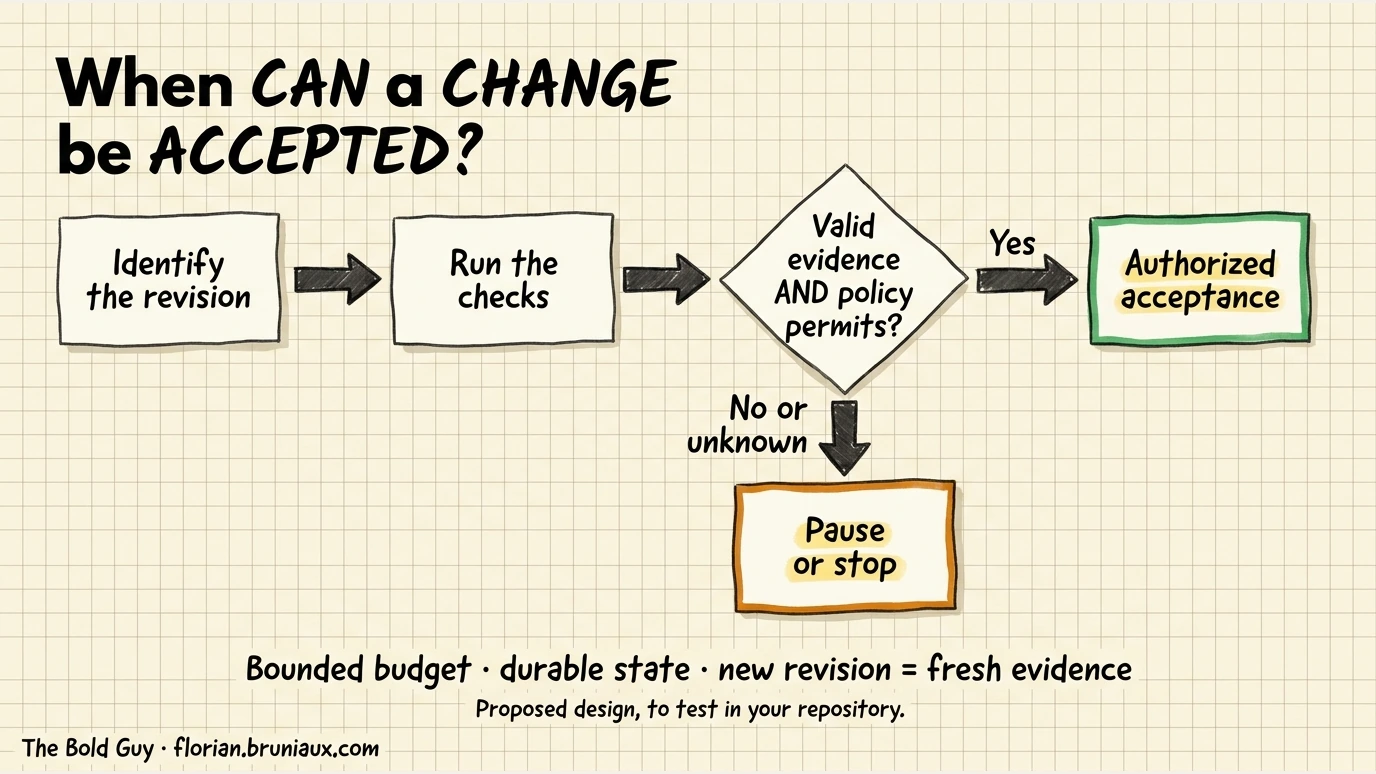
Proposed design, not evidence of a deployed workflow. French version and sources.
7. Observe and evaluate the system
Section titled “7. Observe and evaluate the system”An agent trace needs enough evidence to answer four questions: what ran, why it routed, what state changed, and who accepted the result. Capture data at the layer that made the decision.
| Layer | Minimum evidence |
|---|---|
| Runtime loop | model and harness version, tool calls, permissions, context policy, retry, stop reason |
| Graph | graph and policy version, node, edge, route reason, state before and after, join wait, checkpoint, resume |
| Repository harness | setup command, changed artifact, verifier command, output, exit status |
| Orchestrator | dispatch, ownership, queue wait, handoff, lease, escalation, human checkpoint |
| Judgment | evaluator identity and provenance, evidence references, verdict, overturn, exception authority |
Use stable event names and redact sensitive prompt text, tool arguments, tool results, paths, and identifiers before exporting telemetry. The OpenTelemetry GenAI semantic-conventions repository defines agent, model, request, response, token, and tool telemetry, but its status is Development. Keep an adapter between those conventions and your telemetry backend, and version local graph and judgment fields such as graph.version and verdict.overturned, because the upstream vocabulary can change.
Evaluate the exact model-harness pair, repository revision, permission set, graph version, tool set, budget, and task distribution. A green graph test shows that the control flow followed its contract. It does not prove that the delivered patch meets the requirement. Pair workflow tests with requirement-level verification, recovery drills, and repeated representative tasks. Agent Evaluation defines useful graph-level and reviewer-independence measures.
Limit admission to verification capacity
Section titled “Limit admission to verification capacity”Bound the shared queue as well as each agent run. A task with a finite retry budget can still add work faster than reviewers can accept it. In IFTTD episode 362, Yacine Hmito describes this as a flow problem: faster implementation moves pressure to quality control, and recurring defects should change the upstream production process. Bruno Soulez’s season conclusion goes further by proposing validation before expanding generation; that ordering is his interpretation, not a demonstrated universal sequence.
The comparison with the Toyota Production System is an analogy, not evidence that a software team has reproduced Toyota’s outcomes. Here, an owner-approved pause condition stops new authoring while existing reviews and corrections continue; a confirmed recurring defect becomes a candidate for a tested upstream control.
Name the Lean mechanisms precisely
Section titled “Name the Lean mechanisms precisely”In Lean Software Development, Mary and Tom Poppendieck translate production ideas into software principles such as building quality in and optimizing the whole value stream. That means checking work during creation, rather than relying on a final review gate to find every defect. Measure time to delivery and the later user outcome separately.
- Just-in-Time and kanban: Toyota uses a downstream pull signal to request what the next process needs. The Kanban Method makes work-in-progress (WIP) policies explicit. A board of tickets alone does not establish pull; reserving verification capacity before another agent draft is a proposed software adaptation.
- Jidoka and andon: Toyota distinguishes the stop on abnormality from the visible andon signal. In an agent workflow, early tests and evidence checks can detect a fault, while a policy must actually pause the affected work and route it to correction. A red dashboard light without a stop is only an alert.
- Muda, mura, muri: The Lean Enterprise Institute defines these as waste, unevenness and overburden. Unused drafts or avoidable rework may be muda, bursts of agent submissions mura, and an overloaded review path muri. Those are hypotheses to check against real queues, not diagnoses supplied by an infographic.
- Kaizen: Toyota describes continuous improvement by people. When the same defect returns, change an upstream test, agent instruction or admission rule, then check whether recurrence falls. An alert or an agent retry alone does not demonstrate improvement.
- Poka-yoke: Toyota and the Lean Enterprise Institute use this term for error-proofing at the point of work. In software, a reproducible build, a targeted test or a validation rule can reject a known mistake before review. A check that merely exists, but does not catch the relevant failure, is not evidence of error-proofing.
Two practitioner accounts show different parts of that mechanism. At Qonto, engineers iterated on an Ember-to-React migration tool during a kaizen initiative, combining an AI pass, a deterministic codemod, another AI pass and human review. One engineer, with limited assistance, migrated 8,632 lines in a two-week evaluation. The manual baseline of roughly 50 lines per engineer-day was an estimate, and migrated lines do not measure review cost, escaped defects or user outcomes. In a Theodo account of AP-HP work, a CTO describes stopping an agent after a defect, changing its instructions or checks, resetting and retrying; the reported three-week delivery is compared with an internal two-month estimate. Neither case establishes a transferable speed multiplier or a tested limit for the verification queue.
Repository readiness is an upstream constraint on this flow. In Marek Kalnik’s FlowCon talk, an inconsistent translation file leads an agent to reproduce inconsistent conventions; he argues for shared standards and explicit criteria for an AI-ready project. Factory’s Agent Readiness documentation inventories repository conditions such as reproducible builds, local tests, maintained instructions, observability and security. In Eno Reyes’s talk, the operational argument is to verify one task reliably before multiplying parallel agent work. These are practitioner frameworks, not controlled estimates of delivery improvement. An engineer who knows the repository still has to select the failure worth preventing and judge whether the proposed check captures the intended behavior. Factory uses its own five-level rubric; a score from another radar is not interchangeable with it.
Start from a failure observed on a real task: a missing build command, flaky check, implicit code convention or defect that survived validation. Change one repository control, rerun a comparable task with the same model, environment and acceptance conditions, and record retries, token use, reviewer corrections and elapsed time. Then follow the accepted change through release and the user outcome. A higher readiness score is useful only if the underlying failure becomes less frequent without creating a later queue or hiding defects.
An overloaded downstream queue is a hypothesis to test, not the default outcome of faster generation. The Globo field study reports a shorter Jira task cycle in its setting, with a historical comparator and no user-outcome measure. The admission control below is appropriate when local queue evidence or risk warrants it; it is not a claim that every team must cap agent concurrency.
Before dispatch, reserve capacity for the change’s required verification. Pause new authoring when the owner-approved queue or age limit is reached, a required reviewer is unavailable, or queue telemetry is stale. Allow in-flight reviews and agreed corrections to finish. Resume below a distinct threshold with fresh telemetry and available capacity; otherwise the scheduler can oscillate between pause and resume.
The review admission worksheet defines ownership, atomic reservations, exceptions, and a tabletop exercise. Its illustrative thresholds are not production defaults. Use queue measurements to calibrate them. This complements the per-feature WIP limit in Spec-First Development; it does not grant merge or deployment authority.
8. Three implementation cases
Section titled “8. Three implementation cases”Claude Code: inner loop plus repository harness
Section titled “Claude Code: inner loop plus repository harness”Claude Code owns the interactive model-and-tool loop. The repository harness provides the project contract through CLAUDE.md, optionally importing or symlinking an existing AGENTS.md, plus setup, task state, tests, hooks, and delivery gates. A practical Claude Code design should make the stop rule explicit: for example, a targeted test passes, the change is reviewed against the requirement, and no policy or budget exit has fired. Do not infer a general explicit graph runtime from subagents, teams, or hooks alone. See Agent Harness Engineering for the runtime boundary, the official explanation of the Claude Code agentic loop for product behavior, and the AGENTS.md compatibility section for the supported instruction-file pattern.
Compose recurring triage with bounded work
Section titled “Compose recurring triage with bounded work”A scheduled check discovers work; admission decides whether a candidate may start. A bounded task then pursues a finish condition, while the review policy decides whether the resulting change is acceptable. Practical Loop Engineering describes this combination from Addy Osmani’s practice. Treat it as a workflow proposal, not evidence that a nested command runs successfully.
| Stage | Required evidence or decision |
|---|---|
| Detect | Identify an eligible issue and the repository revision being examined |
| Admit | Check whether the same issue, repository revision and criteria version are already handled or owned by an active run; reserve verification capacity |
| Work | Freeze the task, allowed changes, acceptance criteria and total attempt budget |
| Verify | Reproduce the defect before the fix and retain the relevant checks on the candidate revision |
| Accept or stop | Record the review decision, or the failure, exhausted-budget or escalation reason |
For an illustrative issue-triage run, admit one reproducible bug, keep its identifier across scheduled checks, and produce a candidate patch with test evidence. A later check must not create a second worker for that same active task or reset its consumed budget. Reserve queue capacity before dispatch; the bounded loop contract owns per-task execution. This scenario has not been executed as a Claude Code integration test.
Use the goal reference for completion behavior and the scheduling reference for triggers. Scheduled prompts do not execute built-in commands merely because their names appear in the text. Therefore an example saying “use /goal” inside /loop still needs an explicit, tested invocation boundary. Do not present it as copy-ready orchestration.
Distinguish requested limits from enforced budgets
Section titled “Distinguish requested limits from enforced budgets”A limit written into a /goal condition is judged by the evaluator from the conversation. A controller-enforced budget checks a counter before dispatching another action. The runnable bounded-loop example demonstrates the latter with synthetic actions and a verifier; it does not establish Claude Code behavior. For work that spans sessions, keep total consumption outside the session counters, which reset when an active goal resumes according to the goal documentation.
Completion evaluation also has a narrower role than review. Claude Code’s goal evaluator reads evidence already surfaced in the conversation; it does not independently inspect the patch or rerun commands. A separate reviewer still needs the original requirement, the candidate revision and access to the checks. Passing those checks does not decide whether the change is worth its product cost; that decision belongs to the named acceptance authority.
LangGraph: explicit workflow runtime
Section titled “LangGraph: explicit workflow runtime”LangGraph is appropriate when state, routing, conditional branches, parallel work, interrupts, or persistence must be first-class artifacts. Its official graph API represents state, nodes, and edges explicitly, and its persistence API supplies checkpoints and stores. The engineering work remains in the contracts: state reducers, route conditions, side-effect idempotency, checkpoint selection, and observability.
Liza: repository harness plus control plane
Section titled “Liza: repository harness plus control plane”Liza coordinates external coding-agent CLIs through a persistent task state, worktrees, leases, doer/reviewer roles, recovery, and merge gates. The selected CLI retains its inner tool loop. Its stable pipeline configuration and changing task dependencies make it a useful case for separating organization and work graphs. Its worktree isolation is not a substitute for filesystem, credential, or network sandboxing. The Liza evaluation records the pinned commit and the security boundary.
9. Anti-patterns
Section titled “9. Anti-patterns”| Anti-pattern | Why it fails | Corrective action |
|---|---|---|
| ”Keep trying until done” | no termination, cost, or escalation boundary | write explicit success, failure, budget, timeout, and human exits |
| A diagram without executable semantics | reviewers cannot test routing, joins, or recovery | define state, node contracts, edge conditions, and checkpoint behavior |
| Dynamic topology without policy | an LLM can create hidden loops or unapproved effects | constrain allowed mutations, budget them, log provenance, and validate every route |
| One agent both creates and accepts | self-review can mistake confidence for evidence | separate deterministic checks and sample independent or human review |
| Checkpoints without idempotency | resume can duplicate writes or corrupt state | use effect receipts, idempotency keys, upserts, or compensation |
| Token-only observability | cost cannot explain a bad route, stale state, or incorrect verdict | trace topology, state transitions, evidence, and judgment |
| Calling a scheduler a runtime harness | obscures who owns tool policy and recovery | identify the owner of the actual model-tool-observation loop |
| Treating an REX as a benchmark | one project cannot establish general performance | label REX scope, retain artifacts, and avoid comparative claims |
10. Selection checklist
Section titled “10. Selection checklist”Before adding a loop, graph, or orchestrator, answer yes to each relevant question.
- The selected structure is the smallest one that meets the routing, durability, and authority requirements.
- The loop has explicit success, failure, timeout, budget, and escalation exits.
- State, side effects, evidence, and retention are defined outside the model context.
- Every graph node, edge, join, retry, and checkpoint has a reviewed contract.
- Static policy constrains dynamic task and route creation.
- Deterministic checks own what they can decide deterministically.
- Human authority is named for ambiguity, exceptions, release, and irreversible effects.
- Reviewer independence is measured rather than assumed from role names.
- Resume behavior and side-effect idempotency have been tested under interruption.
- Traces reconstruct routing, state changes, evidence, and verdicts without exporting sensitive payloads.
- Evaluation records the exact model-harness pair, graph version, budget, task set, and failure modes.
Resolve every applicable unchecked contract before increasing the system’s routing scope, side effects, or release authority.