
Navigation Explore Code Guide
AI FinOps guide: cost regimes and levers for coding agents
Last updated:
Reading time: ≈12 minutes
Audience: Developers paying for their own agent usage, tech leads who own a team budget, and platform or procurement owners who choose plans and providers.
Purpose: Entry point of the AI FinOps section. Each question below links to the page that answers it in depth. Dated prices are kept in the LLM market snapshot, not here.
| Question | Start here |
|---|---|
| Are LLM prices going up or down? | LLM market snapshot, §1 |
| What does one day of agent work cost on each provider? | LLM market snapshot, §5 |
| How do I measure what my agent work really costs? | AI unit economics, §2 |
| Which levers reduce cost, and what does each one break? | §3 below |
| Seat, API, or both, for a team? | Subscription strategy |
| How do I cap spend per team or per key? | API gateway |
| When does local or rented hardware beat the API? | Local vs cloud inference |
| How do I track my own sessions? | Observability, cost tracking |
1. Three cost regimes that move independently
Section titled “1. Three cost regimes that move independently”Agent work is paid through three different mechanisms. Each has its own unit, and each can change without the others moving.
| Regime | What you buy | Unit you can compare | What changes it |
|---|---|---|---|
| Subscription quota | A seat with included usage (Claude Pro, Max, Team; ChatGPT Plus, Pro; Cursor; Copilot) | A share of an allowance the vendor does not publish in tokens | Plan multipliers, 5-hour and weekly windows, model weighting, overage rules, which clients may use the seat |
| Metered API tokens | Pay-per-use access to a model | Price per million input, cached input, and output tokens | List price, cache multipliers, batch and off-peak discounts, regional premiums, fast modes, tokenizer changes |
| Owned or rented capacity | A machine or GPU-hours running open-weight models | Cost per GPU-hour, divided by the useful work done at your utilization | Hardware prices, rental rates, model fit, utilization, operating staff |
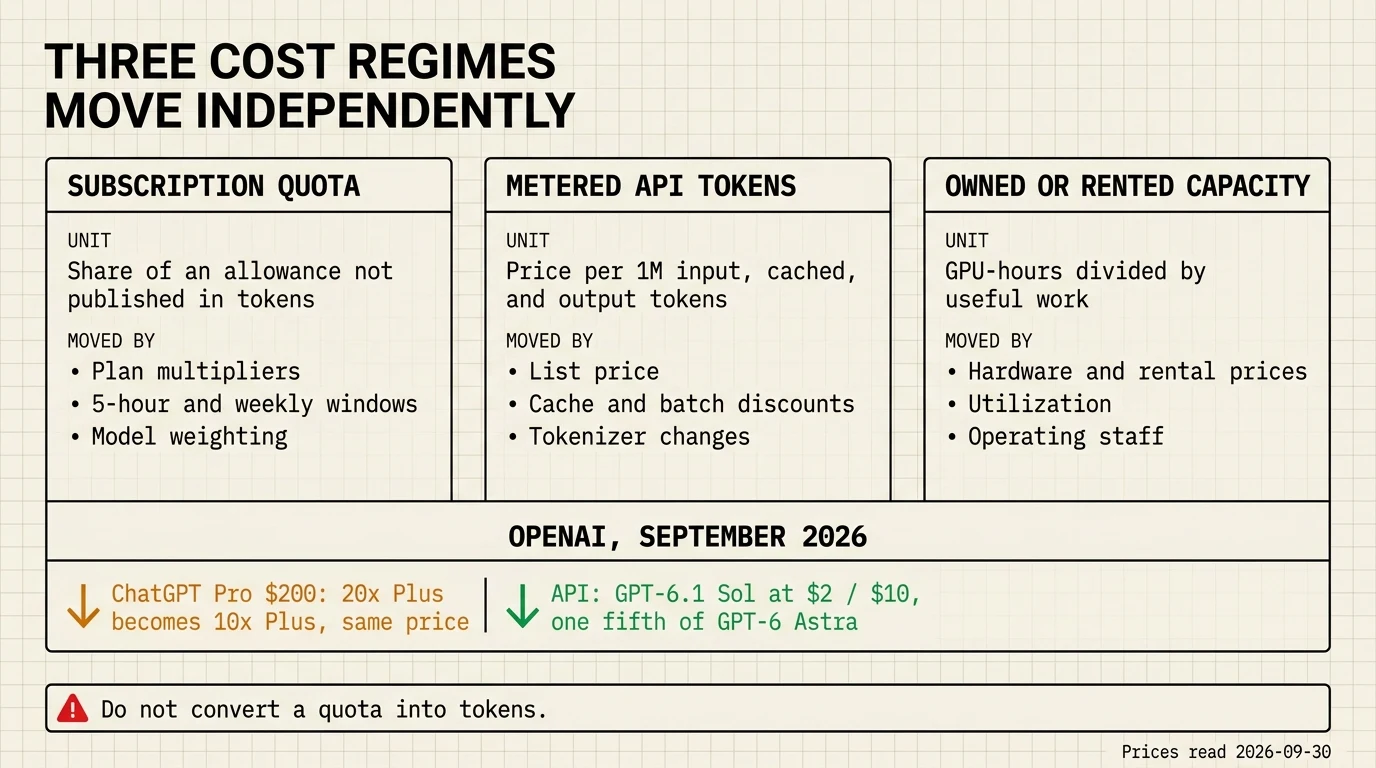
OpenAI in September 2026 shows why the distinction matters. At its September 29 DevDay, OpenAI announced that the usage included in ChatGPT Pro $200 drops from 20 to 10 times the Plus allowance on October 30, at the same price. On September 30, its API price list showed GPT-6.1 Sol at $2 per million input tokens and $10 per million output tokens, one fifth of the GPT-6 Astra rate. A Pro $200 subscriber loses half of the included usage, while an API customer gains a cheaper model. The market snapshot lists the dated changes and their sources.
Two consequences follow:
- Know which regime carries your workload. A headline about “prices going up” says nothing about your bill until you know which regime it concerns.
- Do not convert a quota into tokens. Vendors describe allowances as multiples of another plan (“5x Pro”, “20x Plus”) and weight them by model, effort, and context size. Any token figure you derive is an estimate, not a contract. Measure your own consumption instead (see §2).
Which regime should carry a workload follows from who or what runs it. The routing below condenses the subscription strategy decision table:
2. The FinOps loop applied to agents
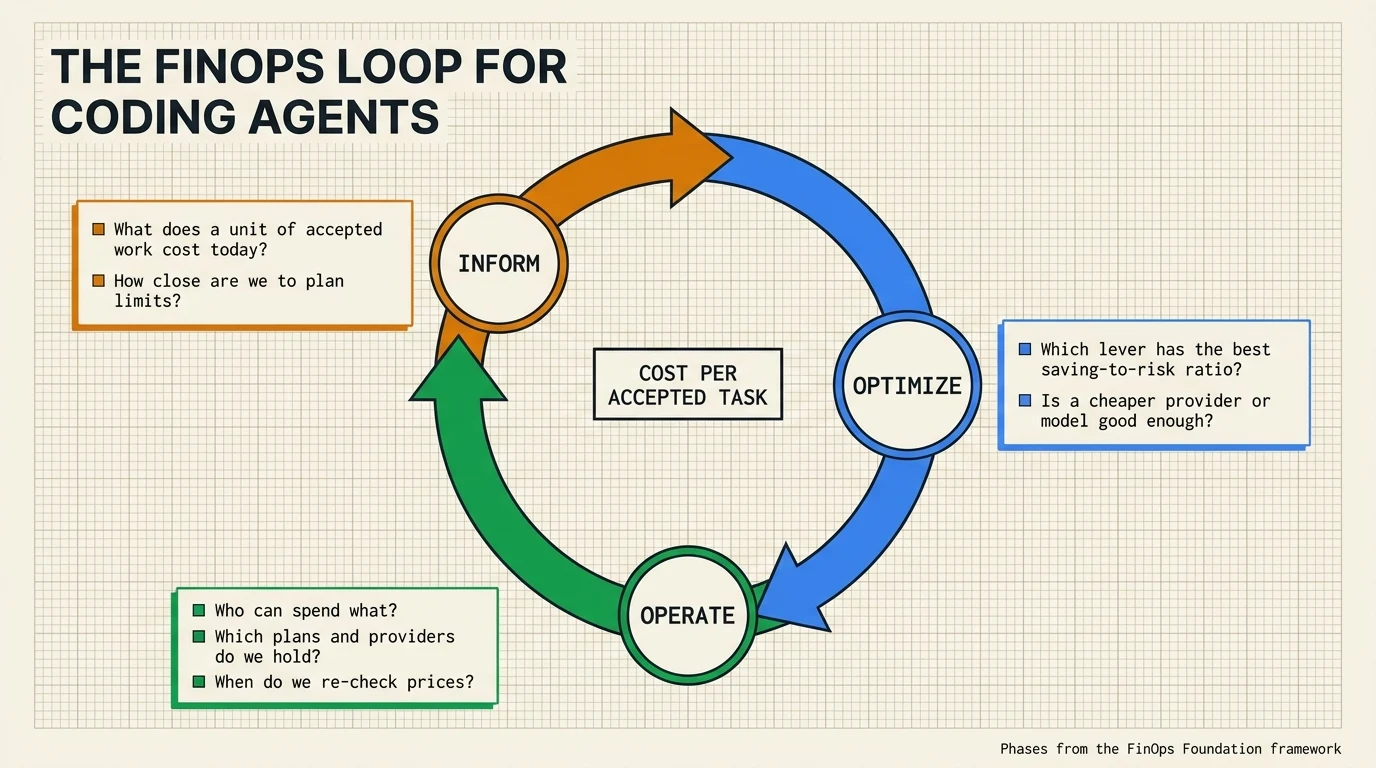
Section titled “2. The FinOps loop applied to agents”The FinOps Foundation framework organizes cost work in three phases: Inform (examine cost, usage, and efficiency data), Optimize (identify ways to improve efficiency and value), and Operate (implement the changes).
| Phase | Question for agent work | What to do | Where |
|---|---|---|---|
| Inform | What does a unit of accepted work cost today? | Record tokens per attempt, cache hit rate, retries, and review time. Divide by accepted tasks, not by requests. | AI unit economics, §2, Observability, /usage in Claude Code |
| Inform | How close are we to plan limits? | Log how often limits interrupt work and which model was active when they did. | Subscription plans and limits |
| Optimize | Which lever has the best ratio of saving to risk for this workload? | Pick from the lever map, test on a sample, compare cost per accepted task before and after. | AI unit economics, §3 |
| Optimize | Is a cheaper provider or model good enough? | Benchmark your own tasks with the same harness. Vendor scores measure a model plus a harness plus an effort setting. | LLM market snapshot, §4 |
| Operate | Who can spend what? | Per-team budgets, virtual keys, model allowlists, progressive spend policies for interactive users, hard caps for unattended agents. | API gateway, AI unit economics, §5 |
| Operate | Which plans and providers do we hold? | Separate workforce seats from production API traffic, run a pilot before committing. | Subscription strategy, §7 |
| Operate | When do we re-check prices? | Re-verify at the primary source before every procurement decision and at least each quarter. | LLM market snapshot, §8 |
3. Lever map
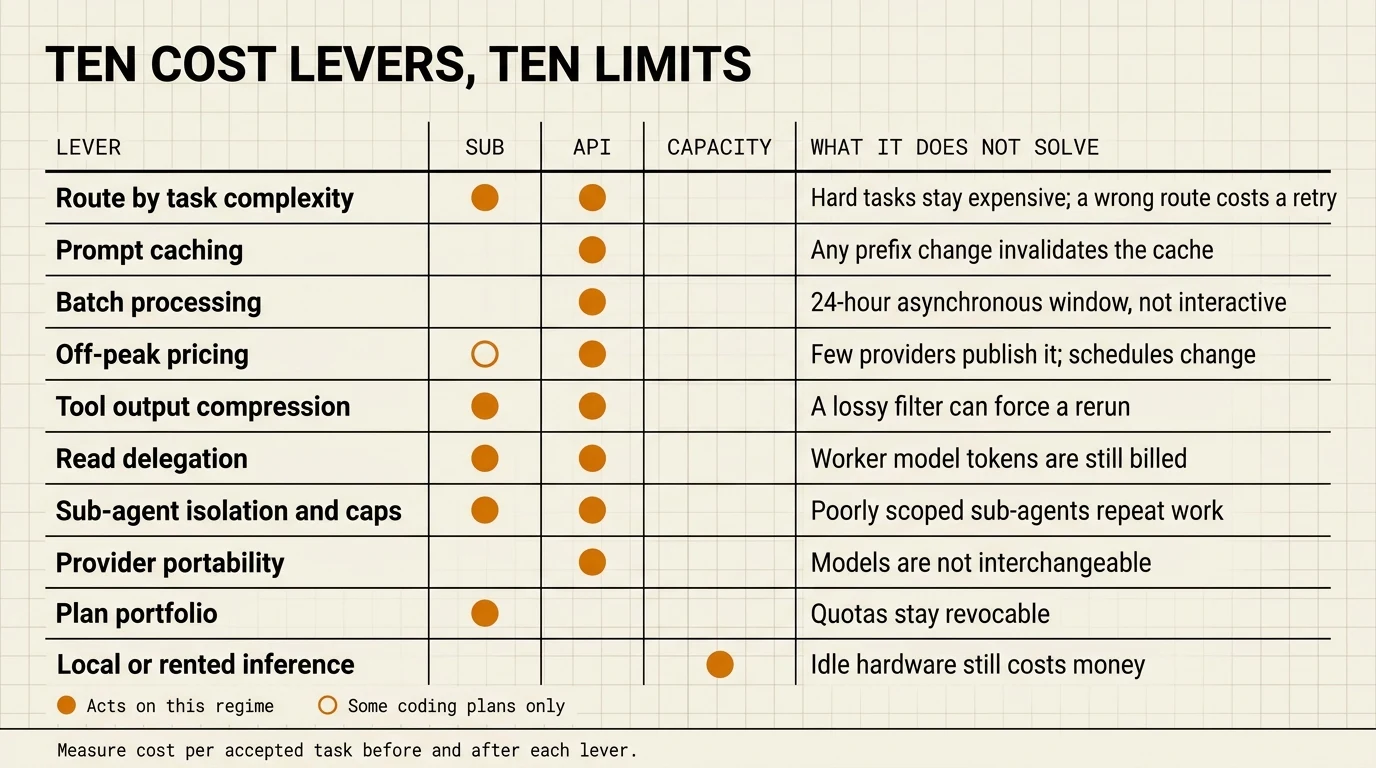
Section titled “3. Lever map”The second column names the regime a lever acts on. The last column lists what the lever leaves unsolved or can make worse, which is why each one needs a before-and-after measurement of cost per accepted task.
| Lever | Regime | Documented in | What it does not solve |
|---|---|---|---|
| Route by task complexity | API, subscription | AI unit economics | A task that genuinely needs the strongest model stays expensive, and a wrong route costs a retry |
| Prompt caching | API | Cost optimization levers | Any change in the cached prefix invalidates it; proxies that rewrite context can break it |
| Batch processing | API | Message Batches API | Requests are processed asynchronously within a 24-hour window, so batch does not fit an interactive loop |
| Off-peak pricing | API, some coding plans | LLM market snapshot, §2 | Among the providers checked, only DeepSeek (API) and Z.AI (coding plan) publish it, and schedules change |
| Tool output compression | API, subscription | Context engineering tools, §3, independent benchmarks | A lossy filter can drop the line the agent needed, which can trigger a rerun; third-party benchmarks found end-to-end effects far below vendor claims, sometimes a higher cost |
| Read delegation to a cheaper model | API, subscription | shunt | The worker model’s tokens are still billed, and it can extract the wrong files |
| Sub-agent isolation and iteration caps | API, subscription | AI unit economics, §3 | Poorly scoped sub-agents repeat work in parallel |
| Provider portability (gateway, bring-your-own-key harness) | API | API gateway, OpenCode | Models are not interchangeable: tool schemas, caching, and reasoning behave differently |
| Plan portfolio | Subscription | Subscription strategy | Quotas stay revocable and are not guaranteed in tokens |
| Local or rented inference | Capacity | Local vs cloud inference | Only open-weight models that fit the hardware are available, and idle hardware still costs money |
To judge a vendor’s claim that a tool “cuts cost by X%”, apply the checklist in AI unit economics, §6: whether the comparison is paired on the same tasks, how many tasks it covers, whether it reports a median or an average, and whether a cut in tokens is also a cut in dollars.
4. What this section does not cover
Section titled “4. What this section does not cover”- A forecast. The section documents dated facts and a method. It does not predict where prices will go.
- Negotiated prices. Volume discounts, committed spend, and reserved capacity are usually private contracts, and the snapshot does not list them.
- Business value. Cost per accepted task is the denominator. Revenue, defects avoided, and customer impact remain a separate exercise per team.
See also
Section titled “See also”- LLM market snapshot: dated prices, quotas, and the trend
- AI unit economics: the measurement framework
- Subscription strategy: seats, APIs, and provider portfolios for teams
- API gateway: budgets, virtual keys, and allowlists
- AI FinOps visual overview: the same regimes and levers as an interactive page with a cost calculator
- Token-saving tools, measured: vendor claims against six public benchmarks
- Context engineering tools: compression and delegation tools with their measured effects
- Local vs cloud inference: hardware, rental, and API break-even